The Causes of Loss Special Form of the Commercial Property Coverage Part in Shoes That Again
The commercial packet policy (CPP) program was started by the Insurance Services Office (ISO) in 1986. Every policy includes iii standard elements: the cover page, mutual policy conditions, and common declarations (shown in Figure 15.1 "Links between the Holistic Take chances Puzzle and Commercial Insurance"). It is of import to elaborate on the declaration folio because it provides a visual aid of the various coverages that can be selected by a business organization, depending on needs. Some businesses may not need specific parts of the parcel, but all the elements are listed for the option of the potential insured. More specifically, the bundle may include the following commercial coverage elements: boiler and mechanism, capital assets plan, commercial car, commercial general liability, commercial inland marine, commercial property, criminal offense and allegiance, employment-related practices liability, farm liability, liquor liability, pollution liability, and professional liability. Some of these coverages were discussed in prior chapters. The residual of the coverages will be described here.
About commercial organizations have similar property exposures. Common business property exposures, along with business income exposures, can exist insured through the commercial property policyPolicy that provides insurance for directly physical loss to business concern holding and income. form of the commercial package policy. The liability module of the commercial package policy is the commercial general liability (CGL) policyThe liability module of the commercial package policy. . Information technology replaced the liability coverage previously available through the comprehensive full general liability policy. In 1986, the CGL was made function of the new modular approach introduced past the ISO in the grade of the CPP.
Commercial Property Coverages
The commercial property policy class of the CPP begins with belongings declarations and atmospheric condition. These provisions identify the covered location, belongings values (and limits), premiums, deductibles, and other specific aspects of the coverage. These pages make the insurance unique for a given policyholder past identifying that policyholder's specific exposures. The information in the declarations must exist accurate for the desired protection to exist. The remainder of the commercial holding coverage consists of the post-obit:
- The building and personal property (BPP) coverage form
- One of three causes of loss forms for the BPP
- Business income coverage (BIC) form
- Endorsements
Straight Property Coverage: The Building and Personal Property (BPP) Course
The BPP provides coverage for direct physical loss to buildings and/or contents equally described in the policy. Dissever sections with distinct limits of insurance are bachelor for both buildings and contents to account for differing needs of insureds. Some insureds volition be tenants who exercise non need building coverage. Others will exist landlords who have limited or no need for contents coverage. Many insureds, of course, will need both in varying degrees.
Covered Property
What constitutes a building and concern personal holding may appear obvious. The insurer, however, must exist very precise in defining its intent considering, as you know, insurance is a contract of adhesion. Ambiguities, therefore, are by and large construed in favor of the insured. Figure fifteen.ii "Edifice every bit Divers in ISO Building and Personal Belongings Coverage Class (Sample)" lists the items defined equally buildings. Effigy 15.3 "Business organization Personal Property as Defined in ISO Edifice and Personal Property Coverage Form (Sample)" lists those items defined as business concern personal belongings.
Figure fifteen.ii Building as Defined in ISO Edifice and Personal Holding Coverage Form (Sample)

Source: ISO Commercial Property Edifice and Personal Holding Coverage Form CP 00 10 06 07. Includes copyrighted material of Insurance Services Office, Inc., with its permission.
Figure 15.3 Business Personal Property equally Divers in ISO Edifice and Personal Belongings Coverage Grade (Sample)
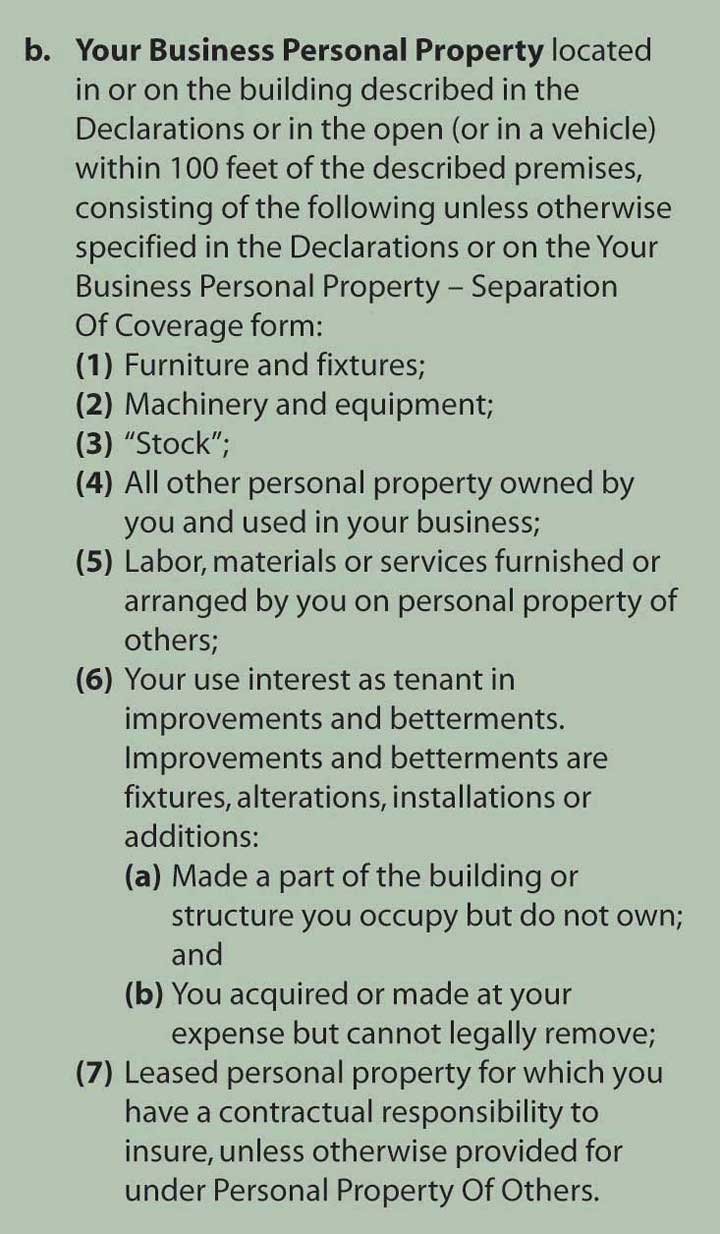
Source: ISO Commercial Property Building and Personal Property Coverage Form CP 00 10 06 07. Includes copyrighted material of Insurance Services Office, Inc., with its permission.
In addition to limiting coverage by defining building and business organization personal belongings, the BPP lists specific property that is excluded from protection. These items are listed in Figure 15.4 "Listed Property Not Covered as Divers in ISO Building and Personal Property Coverage Grade (Sample)". Reasons for exclusions in insurance were discussed earlier. Note in Figure 15.iv "Listed Property Not Covered as Defined in ISO Building and Personal Property Coverage Class (Sample)" and in the corresponding section in the policy the exclusion of "electronic data, except as provided under boosted coverages." In part f (4) of Additional Coverages, discussed beneath and in Effigy fifteen.v "Additional Coverage and Coverage Extension as Listed in ISO Building and Personal Property Coverage Form", the electronic data that is covered is limited to a loss of upwards to $two,500 sustained in one year. The depression limit on electronic equipment and information losses take propelled many businesses to buy the e-commerce endorsement discussed in Chapter 11 "Property Take chances Management". This exclusion is not always noticed by businesses. To ensure adequate coverage, insurers began to offering education programs to hazard managers well-nigh their cyber-risk exposures.
Figure xv.4 Listed Property Not Covered as Defined in ISO Edifice and Personal Property Coverage Form (Sample)
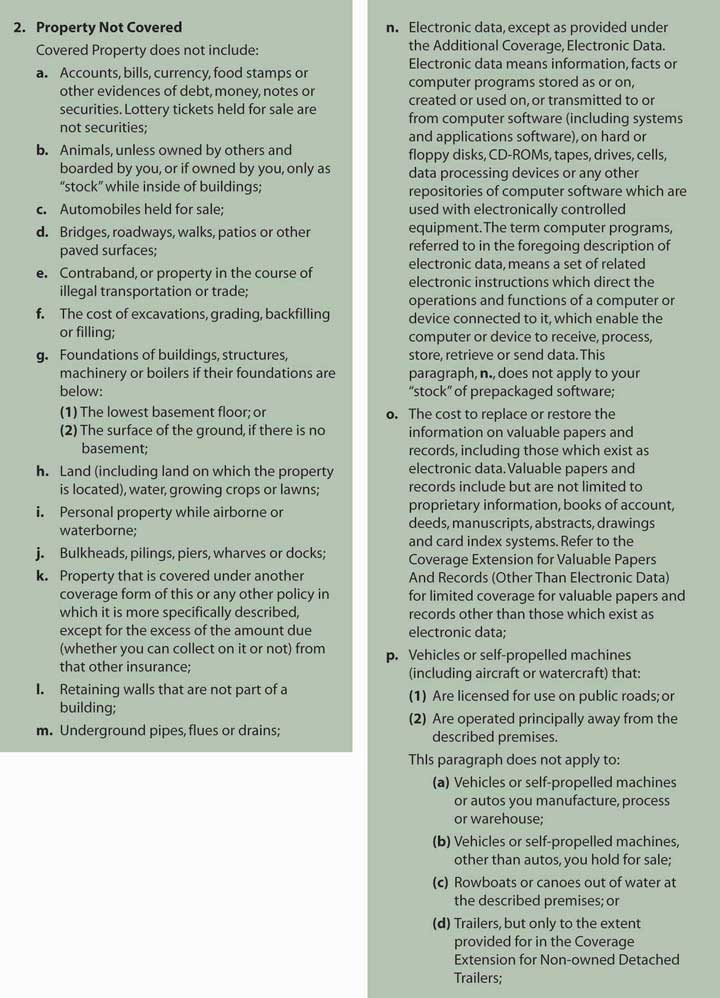
Source: ISO Commercial Property Edifice and Personal Property Coverage Class CP 00 10 06 07. Includes copyrighted material of Insurance Services Office, Inc., with its permission.
Figure 15.5 Additional Coverage and Coverage Extension as Listed in ISO Building and Personal Property Coverage Form
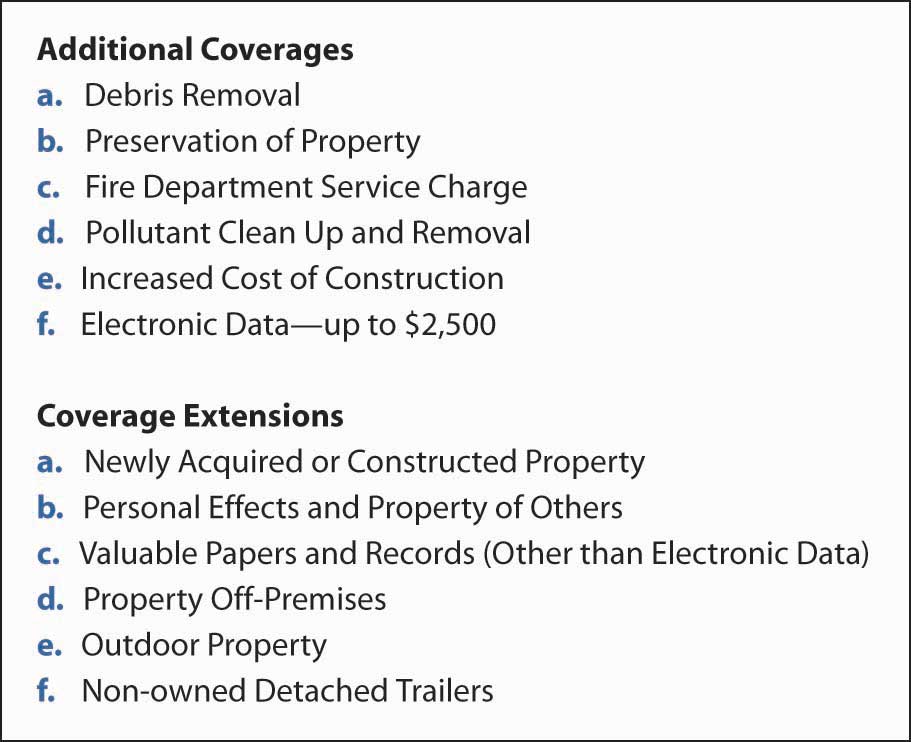
Additional Coverages and Coverage Extensions
In addition to paying for repair or replacement of the listed belongings when caused by a covered peril, the BPP pays for other related costs. The BPP also extends coverage nether specified atmospheric condition. These coverage additions and extensions are listed in Figure fifteen.5 "Additional Coverage and Coverage Extension every bit Listed in ISO Building and Personal Property Coverage Form".
The value of these additional and extended coverages tin can exist significant. Debris removal, for instance, is a cost that is oftentimes overlooked by insureds, but tin involve thousands of dollars. Recent tornadoes in the midwestern U.s.a. caused heavy property harm, and for many insureds, the nigh significant costs involved removal of tree limbs and other debris.
An interesting additional coverage is pollutant cleanup and removalA provision that specifies the conditions under which, and the extent to which, protection for cleanup costs are paid by the insurer. , a provision that specifies the conditions under which, and the extent to which, protection for cleanup costs are paid past the insurer. Because of big potential liabilities, coverage is narrowly defined equally those situations caused past a covered loss, and merely for losses at the described premises. The amount of available protection is too express.
The extended coverages primarily offering protection for properties non included in the definition of covered buildings and personal belongings. The intent is to provide specific and express insurance for these properties, which is why they are separated from the general provision. Newly acquired property and property of others, for instance, involve exposures singled-out from the general exposures, and they require special attending in the coverage extensions. Some of the coverage extensions offer protection confronting loss from a curt listing of causes to property otherwise excluded. Outdoor equipment is an example of property otherwise excluded.
Valuation
Every bit has been discussed in prior chapters, property insurance payments may be made on either a replacement cost new (RCN) basis or an actual cash value (ACV) ground. If the insured chooses actual cash value, and then the provision seven valuation of section East, loss weather condition, applies. The valuation provision involves a number of parts.A detailed description of this part of the policy is beyond the scope of this text. Parts (b) through (east) explicate the insurer's intent for valuation in situations involving RCN when ACV may be hard to measure or inappropriate. Part (b), for instance, permits payment at RCN for relatively pocket-sized losses: those valued at $2,500 or less.
If the insured chooses replacement cost new, this optional coverage must exist designated in the declarations. Further, the insured ought to recognize the demand for higher limits than if ACV is used. Typically, the insurer does not charge a higher rate for RCN coverage; however, more coverage is needed, which translates into a college premium. For RCN to be paid, the insured must actually repair or supercede the covered belongings. Otherwise, the insurer will pay on an ACV basis.
Limits of Insurance
Every bit just discussed, you need to be cautious when selecting an amount of insurance that volition cover your potential losses. The insurer will not pay more than the limit of insurance, except for the coverage extensions and coverage additions (fire department charges, pollution cleanup, and electronic information). In addition to business organisation over having a sufficient amount of insurance to encompass the value of any loss, some insureds demand to worry almost violation of the coinsurance provision, which is establish under section F, additional conditions of the BPP. The policy provides examples of coinsurance. An example of underinsurance in the policy is provided in Tabular array fifteen.1 "Example of Underinsurance in ISO Edifice and Personal Belongings Coverage Course (Sample)" below.
Table 15.ane Case of Underinsurance in ISO Building and Personal Property Coverage Form (Sample)
| Example #1 (Underinsurance) | ||
|---|---|---|
| When: | The value of the belongings is: | $250,000 |
| The Coinsurance pct for it is: | fourscore% | |
| The Limit of Insurance for it is: | $100,000 | |
| The Deductible is: | $250 | |
| The amount of loss is: | $40,000 | |
| Stride (1): | $250,000 × fourscore% = $200,000 | |
| (the minimum amount of insurance to meet your Coinsurance requirements) | ||
| Step (two): | $100,000 ÷ $200,000 = .fifty | |
| Stride (3): | $40,000 × .50 = $20,000 | |
| Step (4): | $20,000 – $250 = $19,750 | |
| Nosotros will pay no more than than $19,750. The remaining $20,250 is not covered. | ||
Source: ISO Commercial Belongings Edifice and Personal Belongings Coverage Form CP 00 10 06 07. Includes copyrighted cloth of Insurance Services Office, Inc., with its permission.
The BPP policy continues to include a coinsurance provision as a major condition of coverage. For virtually insureds, however, there is a pick to override the coinsurance clause with an agreed value selection, plant in section Thousand of optional coverages. The agreed value optionRequires the policyholder to buy insurance equal to 100 percent of the value of the property, as determined at the start of the policy. requires the policyholder to buy insurance equal to 100 percentage of the value of the property, equally determined at the start of the policy. If the insured does and so, so the coinsurance provision does non use and all losses are paid in full, up to the limit of insurance. The wording in the policy is shown in Figure fifteen.half dozen "Agreed Value Choice in ISO Edifice and Personal Holding Coverage Form (Sample)".
Figure 15.6 Agreed Value Option in ISO Building and Personal Property Coverage Form (Sample)
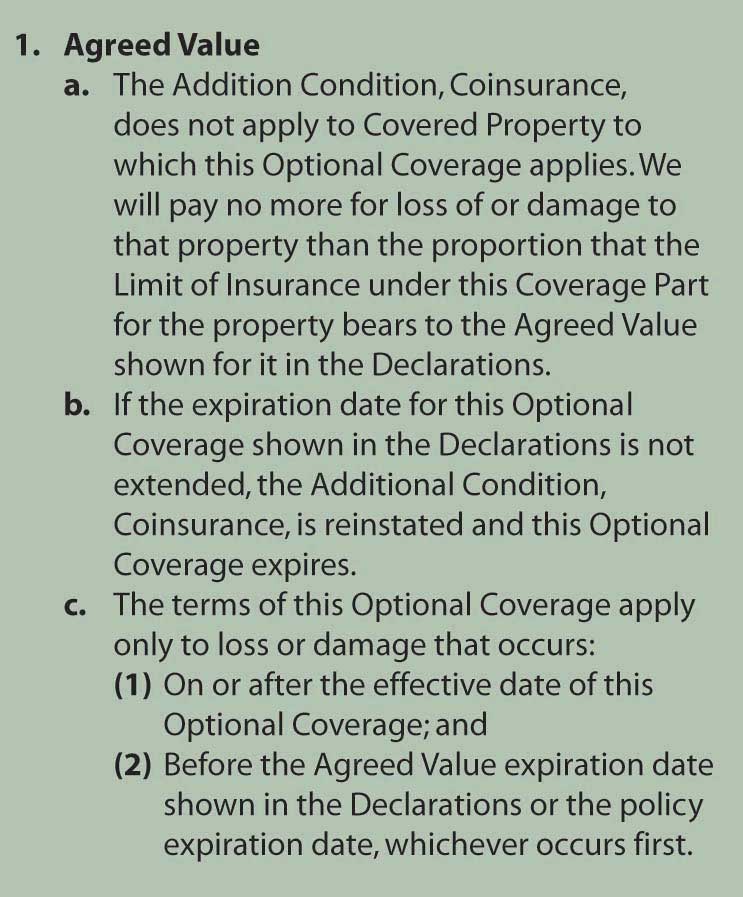
Source: ISO Commercial Property Edifice and Personal Holding Coverage Form CP 00 10 06 07. Includes copyrighted material of Insurance Services Part, Inc., with its permission.
The agreed value option, however, does non ensure that the policyholder will have sufficient limits of insurance to cover a total loss, particularly in times of loftier inflation. To ward off unwanted retentivity of loss values above the limit of insurance, the insured can purchase the inflation guard choice establish in section Thou, optional coverages (which is discussed in Affiliate xiii "Multirisk Management Contracts: Homeowners"). The inflation guard optionProvides for automatic periodic increases in insurance limits; the intent is to keep pace with inflation. provides for automatic periodic increases in insurance limits; the intent is to keep footstep with inflation. The amount of the annual increase is shown as a percentage in the declarations.
Causes of Loss
We take just described some major elements of the BPP form. A full understanding of the coverage requires a thorough reading and consideration of the bear on of each provision. As for which perils are covered, the holding section of the CPP offers iii options: the basic causes of loss form, the broad causes of loss form, and the special causes of loss form.
Causes of Loss—Basic Grade
The bones causes of loss courseA named-perils choice of the commercial belongings policy that covers eleven named perils. is a named-perils option of the commercial property policy that covers eleven named perils (come across Figure xv.7 "Causes of Loss Forms, ISO Commercial Holding Policy"). Some perils are defined and others are not. When exists, the common employ of the term, supplemented past court opinions, will provide its meaning.
Burn, for example, is not defined because information technology has a generally accustomed legal meaning. Insurance policies comprehend but certain fires. While excessive rut may be sufficient for the fire protection to utilise, oxidation that results in a flame or glow is typically required. Farther, the flame must be hostile, not inside some intended container. For instance, if you throw something into a fireplace, intentionally or not, that fire is not hostile and the loss likely is non covered.
A review of the policy and Chapter 13 "Multirisk Management Contracts: Homeowners", where many of these same perils were discussed as they utilise to homeowners coverage, may clarify which loss situations are payable on the basic causes of loss form. Review of the exclusions is just as important.
Figure fifteen.7 Causes of Loss Forms, ISO Commercial Property Policy
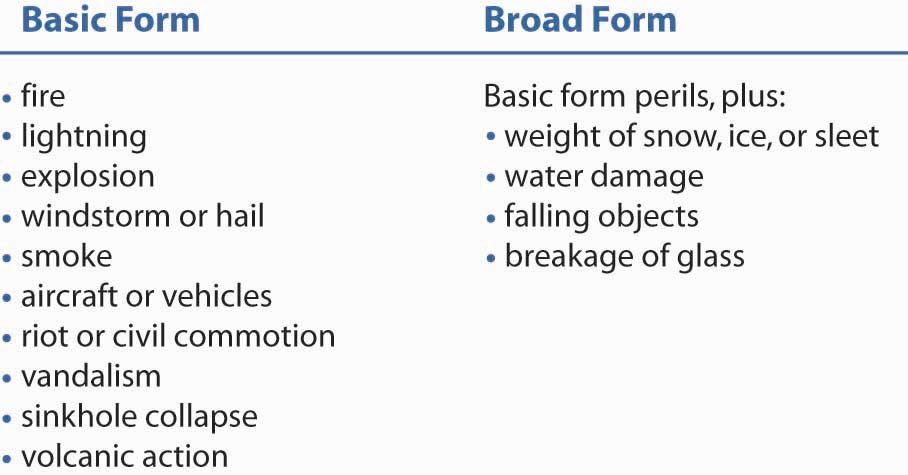
Exclusions found in the basic causes of loss form can be categorized as follows:
- Ordinance of law
- Earth movement
- Governmental activeness
- Nuclear hazards
- Power failure
- War and military activity
- H2o harm
- Fungus, wet rot, dry rot, and bacteria
- Other, involving primarily steam, electrical, and mechanical breakdown
Near of these exclusions involve events with catastrophic potential, such as floods (the water exclusion).
Causes of Loss—Broad Class
The wide causes of loss classA named-perils option of the commercial property policy that covers fifteen named perils. is a named-perils selection of the commercial belongings policy that covers fifteen named perils. It differs from the basic class in adding some perils, as listed in Effigy 15.seven "Causes of Loss Forms, ISO Commercial Property Policy". Geography may dictate, to some extent, preference for the broad class because of its ice and snow coverage. Also note that the water damage peril is for the "sudden and accidental leakage of h2o or steam that results from the breaking or cracking of office of an appliance or system containing water or steam (non a sprinkler system)." It does not cover floods or other similar types of catastrophic water damage.
In addition to adding these perils, the broad form includes a provision to cover collapse caused by the named perils or by hidden disuse; hidden insect or vermin impairment; weight of people or personal holding; weight of pelting that collects on a roof; or use of defective materials in construction, remodeling, or renovation. While this "plummet" additional coverage does not increase the corporeality of coverage available (as the other additional coverages practise), information technology does expand the list of covered-loss situations.
The mold exclusion was discussed in prior chapters. The verbal diction of the exclusion is excerpted from the ISO Causes of Loss—Broad Form in Figure 15.viii "Mold Exclusion as Listed in the ISO Causes of Loss—Broad Form (Sample)".
Figure 15.8 Mold Exclusion as Listed in the ISO Causes of Loss—Broad Form (Sample)
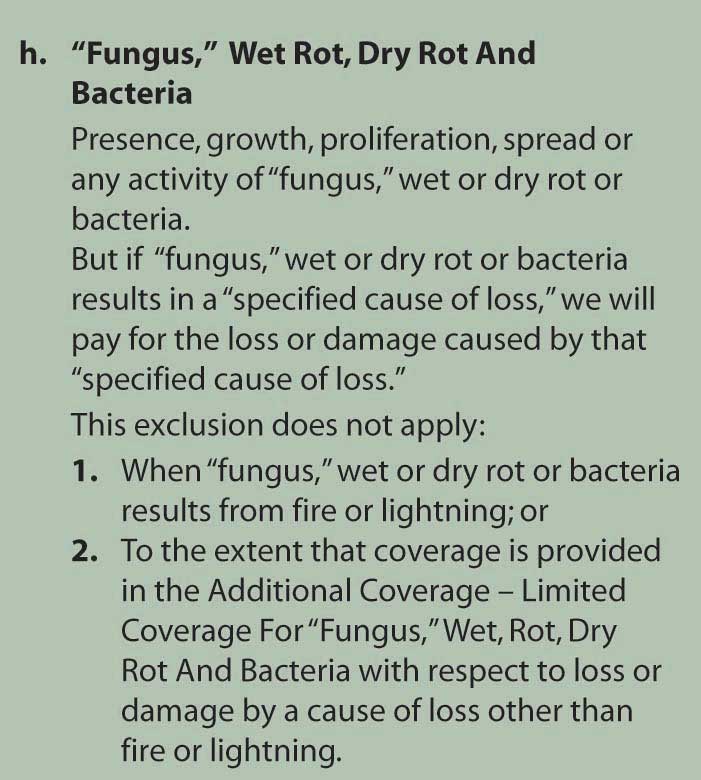
Source: ISO Commercial Property Causes of Loss—Wide Form CP ten 20 06 07. Includes copyrighted material of Insurance Services Office, Inc., with its permission.
The additional coverage in the policy permits a coverage limit for mold for up to only $15,000, as noted in Additional Coverage—Express Coverage For "Fungus," Wet Rot, Dry Rot And Bacteria.
The coverage described under D.2. of this Express Coverage is express to $xv,000. Regardless of the number of claims, this limit is the well-nigh we will pay for the total of all loss or damage arising out of all occurrences of Covered Causes of Loss (other than fire or lightning) and Flood which take place in a 12-month period (starting with the beginning of the present annual policy period). With respect to a particular occurrence of loss which results in 'fungus,' moisture or dry rot or bacteria, we will non pay more than a full of $15,000 even if the 'mucus,' wet or dry rot or bacteria continues to be present or active, or recurs, in a later policy period.ISO Commercial Property Causes of Loss—Wide Form CP 10 20 06 07. Includes copyrighted material of Insurance Services Role, Inc., with its permission.
Concern income coverage volition be discussed in the next section. For now, it is of import to note that, nether the mold exclusion and extension of coverage, business organization break income is provided for just thirty days. The days exercise non need to be sequent.
Returning to the topic of crusade of loss, it is very important to have a clear definition of what is considered a cause of loss for the limits of coverage. Whether or not the peril acquired 1 loss or two split up losses is imperative in agreement the policy. A instance in point is that of the complex decisions regarding whether the loss of the two Earth Trade Center buildings was ane loss or two separate losses from two separate causes of loss. The stakes were very high, at $3.5 billion of limit. To empathise the consequence more clearly, see the box "Liability Limits: I Upshot or Two?"
Liability Limits: One Event or Two?
Did the September 11 terrorist attacks on the Earth Trade Center constitute one loss or two? The resolution to this question is far from simple. Controversy surrounding this issue illustrates the ambiguities inherent in some business insurance contracts.
When the 2 hijacked airplanes struck the Earth Trade Heart towers on the morning of September 11, 2001, the insurance and reinsurance contracts for the property were still under binder agreements. Thus, the wording of the binder agreements became the fundamental issue of this example. At the time of the attacks, existent estate executive Larry A. Silverstein'southward visitor had only recently caused a ninety-nine-year lease on the Globe Merchandise Center and had not even so finalized insurance coverage, which provided up to $iii.five billion in property and liability damage per occurrence. With policies of such size, which take large reinsurance requirements, information technology is not uncommon for the last policies not to be in place when the insured begins operations.
The United Kingdom-based reinsurer Swiss Re had agreed to underwrite 22 percent of coverage on the property in one case the loss exceeded $10 meg, translating into $3.5 billion per occurrence in this case. After the attacks, Swiss Re argued that its preliminary understanding with the lessee divers occurrence as "all losses or damages that are attributable directly or indirectly to i cause or one series of similar causes" and that "all such losses will be added together and the total amount of such losses will be treated as one occurrence irrespective of the catamenia of time or area over which such losses occur." Silverstein, however, argued that each of the airplane crashes was a separate occurrence and his company was due more than $seven billion for the two attacks.
The fuzziness of the linguistic communication has been very problematic. This led to two opposing verdicts in divide court cases. In Phase I, the insurers prevailed. In Phase Two, Silverstein did. The first jury found that "the grade used past banker Willis Group Holdings Ltd., rather than a rival form used by Travelers or other forms, and that the Willis grade, known as WilProp 2000, had specific language that defined what happened to the World Trade Center as a single occurrence." Nether this WilProp class, occurrence means "all losses or damages that are attributable straight or indirectly to ane cause or to one series of like causes. All such losses are added together and the total amount of such losses is treated every bit i occurrence irrespective of the period of fourth dimension or expanse over which such losses occur."
In the second case, the jury agreed with Silverstein that at that place were two occurrences, at least as defined by the temporary insurance agreements that spring the group of insurers that were involved in the 2d instance. As a upshot of the second ruling, Silverstein had an open door to collect "equally much as twice the $1.ane billion aggregate insured amount per occurrence for which the 9 insurers were liable."
These ii contradictory rulings stem from 3 tests:
- The crusade test—The question is, Was there more than one crusade underlying the loss? As such, it can be determined that the fall of the twin towers resulted from one conspiracy by Osama bin Laden.
- The event examination (less prevalent)—The question is, Was there more than one singled-out loss? Equally such, the test looks at each injury or damage to determine the number of losses.
- Unfortunate events test—This test combines the cause test with elements of the effect test; hither, proximity of the cause of loss is of import. Considering in that location were two planes causing the loss, the loss is regarded equally two separate losses.
The World Trade Center cases were heard in a federal court—the U.S. District Court for the Southern District of New York in Manhattan. Ultimately, however, the thing was settled out of court. In March of 2007, New York Insurance Superintendent Eric Dinallo requested that two representatives from Silverstein Properties and each of the 7 insurers involved in the WTC settlement dispute attend a meeting with the state insurance department to bring closure to the ongoing litigation. After weeks of tense negotiations, then-New York Governor Eliot Spitzer and Superintendent Dinallo announced on May 23, 2007, that an understanding between the parties had been successfully brokered. Travelers, Zurich, Swiss RE, Employers Insurance of Wausau, Allianz Global, Industrial Chance Insurers, and Royal Indemnity Company agreed to settle all outstanding courtroom cases and related proceedings for a full of $two billion. Spitzer and Dinallo described this as the largest settlement in regulatory history. Specific amounts paid each company were non disclosed due to confidentiality agreements. The resolution to this dispute removes the last major obstacle to World Merchandise Centre redevelopment as planned by Silverstein Backdrop and the New York and New Bailiwick of jersey Port Potency.
To accost the underlying trouble in the long-delayed loss settlement, Superintendent Dinallo issued a message on October 16, 2008, requiring insurers to provide contract certainty for coverage agreements. This contract certainty called for contract language in insurance policies to be firmed up within 30 days of issuance and the delivery of the policy before, on, or promptly later the policy'southward inception date. This would ensure that policy provisions, similar the question every bit to whether the devastation of the twin towers was 1 insured effect or 2, are definitively established before a loss. Insurance carriers were given twelve months from the engagement of Dinallo's bulletin to bring policies and procedures into compliance with the dominion. When asked by the Risk and Insurance Management Order (RIMS) what would happen if carriers failed to see the compliance deadline, the New York Insurance Department responded that it would "consider regulations spelling out more detailed rules. Regulations have the force of law and penalties can be assessed on licensees." Willis Group Holdings Chairman and CEO Joe Plumeri praised the contract certainty rule, saying, "There is absolutely no alibi for policies to be delivered months later their inception, an all also commonplace practice in this business concern.… We're in the business of keeping promises, and the insurance industry as a whole can do no less. Nosotros believe that the manufacture should law itself, take a principled approach to doing business, and adopt these measures as presently as possible."
The protracted settlement of the Earth Trade Center destruction provides a high-profile example of the bug that tin arise due to uncertain policy terms. This is not typically an issue with virtually insurance policies written on standardized forms approved by the state insurance department. In the instance of large commercial clients, excess and surplus lines, and reinsurance markets, however, it is probable to come up due to complexity of business telescopic, degree of risk, and lack of regulatory authority. Should the contract certainty dominion in New York prove successful in curtailing disputes, RIMS anticipates that additional states volition follow suit in passing similar requirements.
Questions for Discussion
- Which ruling do you agree with in this circuitous case? What is the justification for the ruling against the addressee in this case, and the one in favor of the leaseholder? Practice you call back this ruling is upstanding in lite of the massive loss?
- In ethical terms, who should really endure the burden of the attack on America on September 11? Should it be whatsoever private citizen or the private insurance industry?
Sources: E. E. Mazier, "Swiss Re Presses 'One Attack' Theory," National Underwriter, Property & Casualty/Risk & Benefits Management Edition, October 29, 2001; E. Eastward. Mazier, "Experts View Swiss Re WTC Lawsuit as Unprecedented Legal Quagmire," National Underwriter Online News Service, October 31, 2001; Marker E. Ruquet, "Insurers to Lose WTC Case: Agent Univ.," National Underwriter Online News Service, July 22, 2002; East. Eastward. Mazier, "Judges Sends WTC Merits to Jury Trial," National Underwriter, Belongings & Casualty/Risk & Benefits Management Edition, June x, 2002; E. E. Mazier, "Gauge Rules WTC Terror Is 1 Event," National Underwriter Online News Service, September 25, 2002; E. E. Mazier, "Swiss Re Silverstein WTC Case in Abattoir," National Underwriter Online News Service, September 27, 2002; "Tale of Two Trials: Contract Linguistic communication Underlies Contradictory Earth Trade Center Verdicts," BestWire, Dec 9, 2004, accessed March 27, 2009, http://www3.ambest.com/Frames/FrameServer.asp?AltSrc=23&Tab=ane&Site=news&refnum=70605; Marking East. Ruquet, "Spitzer Spearheads $two Billion WTC Insurance Settlement," National Underwriter, Holding & Casualty/Take a chance & Benefits Management Edition, May 23, 2007, accessed March 29, 2009, www.property-casualty.com/News/2007/5/Pages/Spitzer-Spearheads--2-Billion-WTC-Insurance-Settlement.aspx; Mark East. Ruquet, "WTC Bargain Gets Dinallow Off on Right Human foot," National Underwriter, Holding & Casualty/Risk & Benefits Management Edition, June eighteen, 2007, accessed March 29, 2009, world wide web.holding-casualty.com/Bug/2007/24/Pages/WTC-Deal-Gets-Dinallo-Off-On-Correct-Human foot.aspx; Daniel Hays, "New N.Y. Regulation Calls For Policy Contract Certainty," National Underwriter, Property & Casualty/Risk & Benefits Management Edition, Oct 16, 2008, accessed March 29, 2009, www.belongings-prey.com/News/2008/x/Pages/New-N-Y--Regulation-Calls-For-Policy-Contract-Certainty.aspx; Daniel Hays, "RIMS Reacts to N.Y. Contract Certainty Regulation," National Underwriter, Holding & Prey/Risk & Benefits Management Edition, October 22, 2008, accessed March 29, 2009, www.property-casualty.com/News/2008/ten/Pages/RIMS-Reacts-To-Northward-Y--Contract-Certainty-Regulation.aspx; Mark Eastward. Ruquet, "Willis CEO Applauds North.Y. Move On Contract Certainty," National Underwriter, Property & Casualty/Risk & Benefits Direction Edition, October 17, 2008, accessed March 29, 2009, http://www.holding-casualty.com/News/2008/ten/Pages/Willis-CEO-Applauds-N-Y--Move-On-Contract-Certainty.aspx; See all media coverage at the stop of 2004 and afterward.
Causes of Loss—Special Course
The special causes of loss courseAn open perils or all risk coverage option for the commercial holding policy. is an open perils or all run a risk coverage option for the commercial property policy. That is, instead of listing those perils that are covered, the special class provides protection for all causes of loss not specifically excluded. In this form, so, the exclusions ascertain the coverage. Remember that all those exclusions listed in the basic form, except for the "other" category and some aspects of the water impairment exclusion, apply to the special form.
Nigh of the boosted exclusions constitute in the special course relate either to catastrophic potentials or to nonfortuitous events. Amid the catastrophe exclusions are banality or machinery explosions. Nonfortuitous exclusions relate to items such every bit article of clothing and tear, smoke from agricultural smudging, and damage to a building interior caused by weather conditions, unless the building exterior is damaged beginning.
Some experts believe that the greatest do good of the special course over the broad class is coverage against theft. You may recall that theft is not a listed peril in the broad or the basic class. Coverage of theft from any cause, nonetheless, is too costly for most policyholders. The special grade, therefore, includes some limitations on this protection. For example, employee dishonesty and loss of belongings that appears to have been stolen but for which there is no concrete evidence of theft ("mysterious disappearance") are not covered. In addition, certain types of belongings such as patterns, dyes, furs, jewelry, and tickets are covered against theft only up to specified amounts. The special form likewise provides coverage for belongings in transit.
Consequential Property Coverage: Business Income Coverage (BIC)
In addition to the cost of repairing and/or replacing damaged or lost property, a business is probable to experience some negative consequences of being unable to apply the damaged or lost belongings, which was noted in previous chapters. Those negative consequences typically involve reduced revenues (sales) or increased expenses, both of which reduce net income (turn a profit). The commercial property policy provides coverage for net income losses through the business income coverage (BIC)Protects against both business concern interruption and extra expense losses. class. The BIC protects against both business interruption and extra expense losses.
Business Interruption
When operations shut down (are interrupted) because of loss to concrete belongings, a business likely loses income. The definition of business concern income in the BIC is provided in Figure 15.ix "Business Income equally Defined in the ISO Business Income (and Extra Expense) Coverage Form (Sample)".
Effigy fifteen.9 Business Income as Defined in the ISO Business Income (and Extra Expense) Coverage Form (Sample)
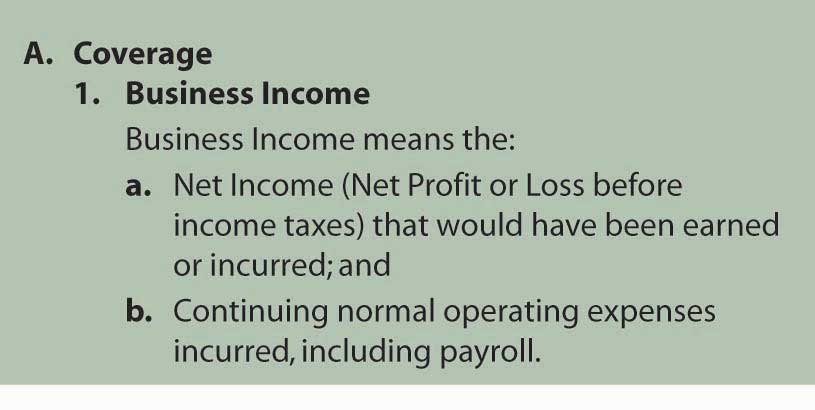
Source: ISO Commercial Property Business Income (and Extra Expense) Coverage Class CP 00 30 06 07. Includes copyrighted material of Insurance Services Office, Inc., with its permission.
Normal operating expenses are those costs associated with the activity of the business, not the materials that may be consumed past the business. Included among operating expenses are payroll, heat and lighting, advertizement, and interest expenses.
The intent of the BIC is to maintain the insured's same financial position with or without a loss. Payment, therefore, does not comprehend all lost revenues because those revenues generally cover expenses, some of which will not keep. Still because some expenses continue, coverage of net income solitary is bereft. An example of a BIC loss is given in "Business Income Coverage (BIC) Hypothetical Loss."
Information technology is important to note the wording in the policy. The coverage applies only to concern interruption for damages to the holding in the proclamation. More specifically, the policy states,
We will pay for the actual loss of Business Income you sustain due to the necessary 'break' of your 'operations' during the 'flow of restoration.' The 'interruption' must be acquired past directly physical loss of or damage to property at premises which are described in the Declarations and for which a Business concern Income Limit of Insurance is shown in the Declarations. The loss or damage must be caused by or result from a Covered Crusade of Loss. With respect to loss of or damage to personal belongings in the open or personal property in a vehicle, the described bounds include the area within 100 feet of the site at which the described premises are located.ISO Commercial Belongings Business Income (and Extra Expense) Coverage Form CP 00 30 06 07. Includes copyrighted material of Insurance Services Part, Inc., with its permission.
Nether this policy, businesses that sustained losses considering of the economical backlash and fear after September 11, 2001, would not be covered for their loss of income. For discussion of this issue, read the box "Business Interruption with and without Direct Concrete Loss" in Chapter 11 "Holding Risk Management".
As noted above in the discussion of the BPP policy, this role of the commercial package also limits coverage for interruption to computer operations under Section 4, as presented in Figure 15.10 "Interruption of Computer Operations Coverage Limitation in the ISO Business Income (and Extra Expense) Coverage Form (Sample)".
Figure 15.10 Interruption of Computer Operations Coverage Limitation in the ISO Business Income (and Extra Expense) Coverage Course (Sample)
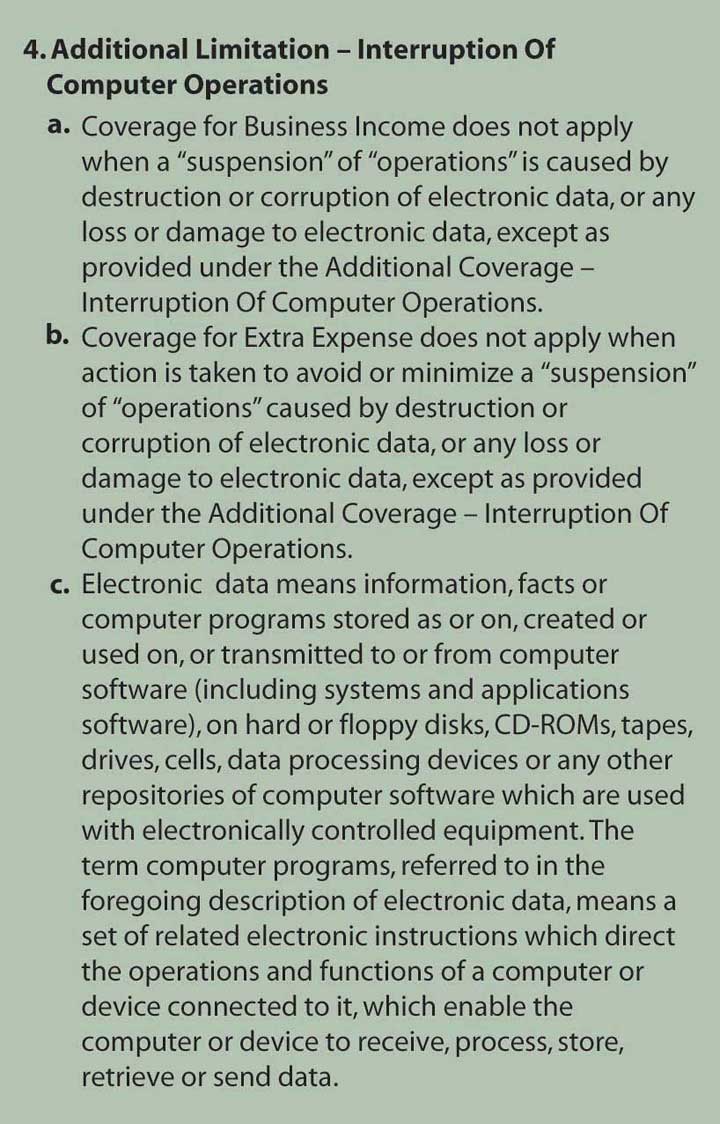
Source: ISO Commercial Property Business Income (and Extra Expense) Coverage Form CP 00 30 06 07. Includes copyrighted fabric of Insurance Services Part, Inc., with its permission.
In Additional Coverage, the amount available for interruption of computer functioning is $2,500. No wonder many businesses today purchase the eastward-commerce endorsement or buy the new policies from the companies described in Affiliate 11 "Property Risk Management" and Chapter 12 "The Liability Adventure Management".
Extra Expense
In add-on to losing sales, a business organization may demand to incur various expenses post-obit holding harm in order to minimize farther loss of sales. These actress expenses are too covered past the BIC. A bank, for example, could not simply shut down operations if a burn down destroyed its building considering the bank's customers rely on having fix access to financial services. As a result, the bank is likely to ready up operations at a temporary location (thus reducing the extent of lost revenues) while the damaged belongings is beingness repaired. The rent at the temporary location plus any increment in other expenses would be considered covered extra expenses.
Causes of Loss
The aforementioned 3 perils options available for the BPP are too available for the BIC. Considering the BIC requires that the covered income loss results from direct concrete loss or damage to holding described in the declarations, near insureds choose the aforementioned causes of loss form for both the BPP and the BIC. Now, we bear witness a more detailed instance of a hypothetical loss that occurred during the Chicago flood in 1992.
Business Income Coverage (BIC) Hypothetical Loss
In the jump of 1992, Chicago experienced an unusual flood apparently caused past damage to an underground tunnel system. Many firms were required to shut downwards offices in the damaged area. Among them were large bookkeeping organizations, just ii weeks earlier the tax deadline of April fifteen. Thus, the losses were magnified by the fact that the flood occurred during the tax flavour. Assume the following hypothetical conditions for one of those firms.
| Preloss Financial Information | |
|---|---|
| Average monthly revenues | $500,000 |
| Average April revenues (stated in 1992 dollars) | $700,000 |
| Boilerplate monthly payroll | $300,000 |
| Average Apr payroll | $550,000 |
| Monthly heat, electricity, water | $25,000 |
| Monthly rent for leased office | $45,000 |
| Monthly interest expense | $10,000 |
| Monthly marketing expense | $fifteen,000 |
| Monthly other expenses | $x,000 |
| Cyberspace income in Apr | $45,000 |
| Postloss Financial Information for Apr 1992 | |
|---|---|
| Revenues | $600,000 |
| Payroll | $540,000 |
| Utilities | $xxx,000 |
| Rent on downtown space | $0 |
| Rent for temporary space | $50,000 |
| Interest expense | $10,000 |
| Marketing expense | $22,000 |
| Other expenses | $20,000 |
| Net loss | ($72,000) |
This firm experienced both a reduction in revenue and an increase in expenses. The resulting profit (net income) loss is the covered loss in the BIC. For this case, the loss equals $117,000, the sum of the income not received ($45,000) that would have been expected without a loss, plus the actual lost income ($72,000) incurred. Such a substantial loss for a two-week menstruum is non unusual.
Coinsurance
The coinsurance provision of the BIC is i of the more confusing parts of whatsoever insurance policy. Its purpose is the same as that discussed earlier, which is to maintain equity in pricing. Its awarding is also similar. The difficulty comes in defining the underlying value of the total exposure, which is needed to apply any coinsurance provision. Following in Tabular array 15.ii "Example of Underinsurance in ISO Concern Income (and Extra Expense) Coverage Grade (Sample)" is an underinsurance case from a BIC policy. More examples are provided in the policy sample.
Table 15.2 Example of Underinsurance in ISO Business concern Income (and Actress Expense) Coverage Form (Sample)
| Case #1 (Underinsurance) | ||
|---|---|---|
| When: | The Net Income and operating expenses for the 12 months post-obit the inception, or final previous anniversary appointment, of this policy at the described bounds would take been: | $400,000 |
| The Coinsurance percent is: | 50% | |
| The Limit of Insurance is: | $150,000 | |
| The amount of loss is: | $80,000 | |
| Step (1): | $400,000 × 50% = $200,000 | |
| (the minimum amount of insurance to meet your Coinsurance requirements) | ||
| Footstep (2): | $150,000 ÷ $200,000 = .75 | |
| Footstep (3): | $80,000 × .75 = $60,000 | |
| Nosotros will pay no more than than $60,000. The remaining $twenty,000 is not covered. | ||
Source: ISO Commercial Belongings Business Income (and Actress Expense) Coverage Form CP 00 30 06 07. Includes copyrighted material of Insurance Services Role, Inc., with its permission.
Remember that a BIC loss equals net income plus standing operating expenses. Coinsurance, however, applies to net income plus all operating expenses, a larger value. The amount of insurance required to run into the coinsurance provision is some percentage of this value, with the percent determined past what the insured expects to be the maximum period of interruption. If a maximum interruption of vi months is expected, for example, the proper coinsurance percentage is fifty percentage (6/12). If information technology is nine months, a coinsurance percentage of 75 percentage (ix/12) is appropriate.
Considering of the complexity of the coinsurance provision, however, many insureds choose an agreed value choice. This choice works under the same principles as those discussed with regard to the BPP. Using the example illustrated in "Concern Income Coverage (BIC) Hypothetical Loss," we tin demonstrate the awarding of the coinsurance provision. Coinsurance requirements use to net income plus operating expenses ($95,000 plus $405,000 per calendar month on average, or $6,000,000 for the twelvemonth). If a fifty percentage coinsurance provision is used considering the expected maximum menstruation of interruption is half dozen months, and so the amount of insurance required is $iii,000,000 (0.fifty × $6,000,000). If the April figures are representative (which is really not the case with a taxation accounting role), then a half-dozen-month intermission would effect in a much lower loss.
Other Options
The BIC includes a number of options designed to change coverage for the insured's specific needs. Three options that bear on the coinsurance provision are the monthly limit of indemnity, maximum menstruum of indemnity, and payroll endorsements. For better understanding, the educatee is invited to read the policy in addition to reading the post-obit explanations.
The monthly limit of indemnityNegates the coinsurance provision of business income coverage; instead, a total limit is listed, every bit is the percentage of that limit available each month. negates the coinsurance provision of business income coverage; instead, a total limit is listed, as is the percent of that limit available each month. The policy uses the instance of a $120,000 limit and ¼ monthly corporeality. For this example, only $30,000 (¼ × $120,000) is available each month. An arrangement with stable earnings and expectations of a curt menstruation of restoration would likely find this pick worthwhile.
The maximum period of indemnityOption likewise negates the coinsurance provision of the BIC; instead, this pick limits the duration of coverage to 120 days (or until the limit is reached, whichever comes beginning). option likewise negates the coinsurance provision of the BIC; instead, this selection limits the duration of coverage to 120 days (or until the limit is reached, whichever comes starting time). Both the maximum catamenia of indemnity and the monthly limit of indemnity address the fact that the standard policy cannot be used with a coinsurance provision of less than 50 percent (vi months).
Instead of negating the coinsurance provision, as exercise the two options just discussed, the payroll endorsementAllows the insured to deduct some or all payroll expenses from the value of operating expenses before calculating the coinsurance requirement. allows the insured to deduct some or all payroll expenses from the value of operating expenses before calculating the coinsurance requirement. Doing so allows the insured to purchase less insurance (and unremarkably pay lower premiums) and withal meet the coinsurance provision. It also excludes payroll from covered expenses, yet, and so the insured must experience confident that payroll would not be maintained during a shutdown. A common payroll endorsement includes ninety days of payroll expense in the coinsurance calculation (and BIC coverage), assuming that a brusque shutdown might allow the insured to continue to pay employees. For a longer shutdown, termination of employment might be more cost effective.
Key Takeaways
In this section you studied the commercial package policy (CPP) and the commercial property component of the CPP:
- The commercial packet policy (CPP) is a modular business organisation insurance option that bundles coverages such equally commercial property, commercial full general liability, commercial inland marine, professional liability, and more, into a single policy.
- The CPP contains the standard elements: cover folio, mutual policy conditions, and mutual declarations.
- Common business property exposures are insured through the commercial property policy of the CPP.
- Property declarations and conditions of the commercial belongings policy form identify the covered location, property values and limits, premiums, deductibles, and other items.
- The commercial property policy'south building and personal property (BPP) form provides coverage for direct concrete loss to buildings and contents and additional or extended coverages, per the insured'due south valuation provision upwardly to the limits of insurance and subject to listed exclusions.
- Three causes of loss options are available in the BPP: basic (xi named perils), wide (fifteen named perils), and special (open up perils), all subject field to exclusions.
- The commercial belongings policy provides coverage of net income losses equally a result of being unable to use damaged or lost property through the business organization income coverage (BIC) form.
- BIC protects against business interruption and actress expense losses.
- The BIC offers the same three crusade of loss options equally the BPP.
- Both the BPP and the BIC are discipline to coinsurance provisions; this can be modified in the BIC through use of the monthly limit of indemnity, maximum catamenia of indemnity, and payroll endorsements.
Discussion Questions
- What types of property are covered in the BPP? What are some examples of excluded property, and why are they excluded?
- How tin an insured get around the coinsurance provision in the BPP? Why might an insured adopt to do this?
- What kinds of losses are covered in the BIC? Provide examples.
- The building where Alpha Mortgage Company's office was located received minor smoke impairment, forcing the company to relocate its operations for one month. Assuming standard BIC coverage and the following hypothetical conditions, what amount of benefits could the visitor expect to receive?
Preloss Fiscal Information Average monthly revenues $220,000 Average monthly payroll $100,000 Monthly heat, electricity, h2o $25,000 Monthly hire for leased part $25,000 Monthly involvement expense $10,000 Monthly marketing expense $5,000 Monthly other expenses $5,000 Postloss Financial Information for Ane Calendar month Revenues $170,000 Payroll $100,000 Utilities $30,000 Rent on leased function $0 Hire for temporary infinite $50,000 Interest expense $0 Marketing expense $six,000 Other expenses $12,000 - The Bravo Multiplex Movie Theater has a BIC coverage limit of $200,000 with a coinsurance percentage of 50 percent. Over the previous 1-year period, the theater'due south net income and operating expenses totaled $400,000. If Bravo is forced to shut downwards 1 of its eight theaters for 6 months (incurring a total loss of $60,000), how much volition BIC cover? Does the company have enough insurance? Practise they take other options?
-
Assume that the Steinman Shoe Station owns the $1 one thousand thousand building in which information technology operates, maintains inventory and other concern properties in the building worth $700,000, and frequently has possession of people'south property upwardly to a value of $50,000 while they are being repaired. For each of the following losses, what, if annihilation, will Steinman's BPP insurer pay? Limits are $one million on coverage A and $800,000 on coverage B. The broad causes-of-loss form is used and there was no eastward-commerce endorsement. Explain your answers.
- Wind harm rips off tiles from the roof, costing $20,000 to supercede. The actual greenbacks value is $17,000.
- An angry arsonist starts a fire. The building requires repairs of $fifteen,000, $17,000 of inventory is destroyed, and $2,000 of other people's belongings is burned.
- A water pipage bursts, destroying $22,000 of inventory and requiring $10,000 to repair the pipage.
- The estimator system crashes for three days.
-
Steinman also bought a BIC with a limit of $250,000 and a 50 percent coinsurance clause. No other endorsements are used. A limited income argument for concluding year is shown below.
Revenues $two,000,000 Less: Toll of goods sold $800,000 Utilities $200,000 Payroll $400,000 Other expenses $300,000 $1,700,000 Profit $300,000 - How much in expenses does Steinman expect to be noncontinuing in the outcome of a shutdown? Explain.
- What is the longest shutdown flow Steinman would expect post-obit a loss?
- If a iii-month endmost occurred following the roof collapsing due to the weight of snow, what do yous think would be the loss? Explicate.
Source: https://saylordotorg.github.io/text_risk-management-for-enterprises-and-individuals/s19-01-commercial-package-policy-and-.html
0 Response to "The Causes of Loss Special Form of the Commercial Property Coverage Part in Shoes That Again"
Enviar um comentário